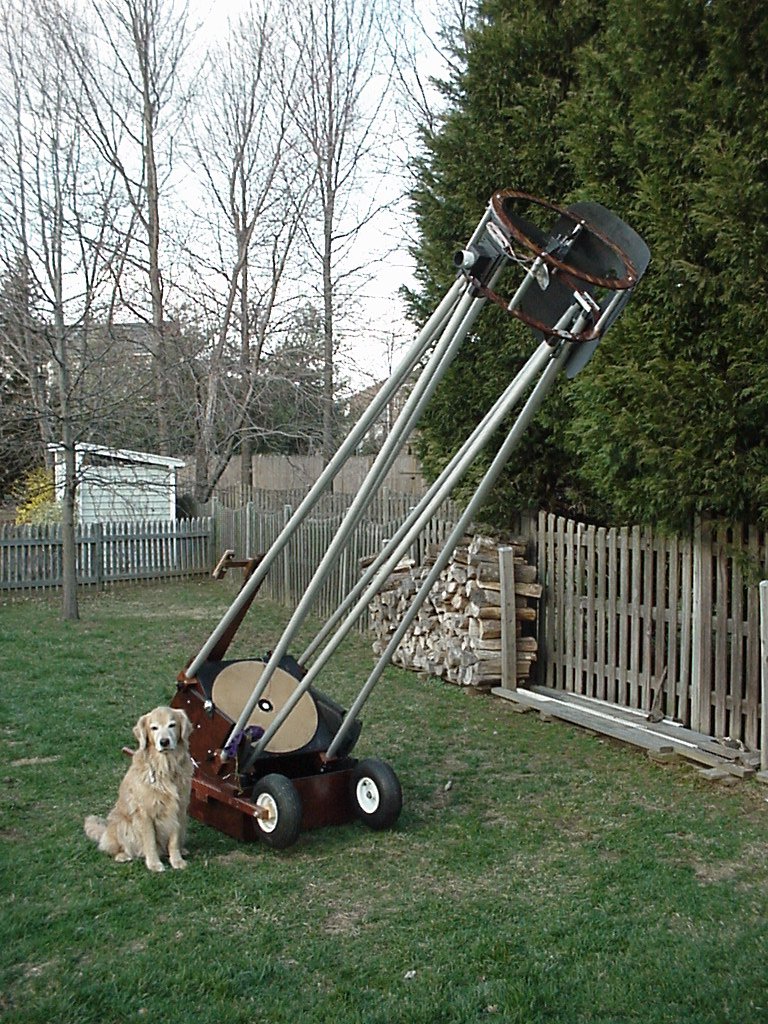

"TJ": Bob and Cathy's 20-inch Telescope, the history of a 35 year old Dobsonian
Last touched 2023 March 15
This page attempts to document the history and evolution of a 20-inch telescope that is 35 years of age as of 2019. The telescope has seen a couple of different owners, lived in three different parts of the US and been rebuilt into a different physical form three times.
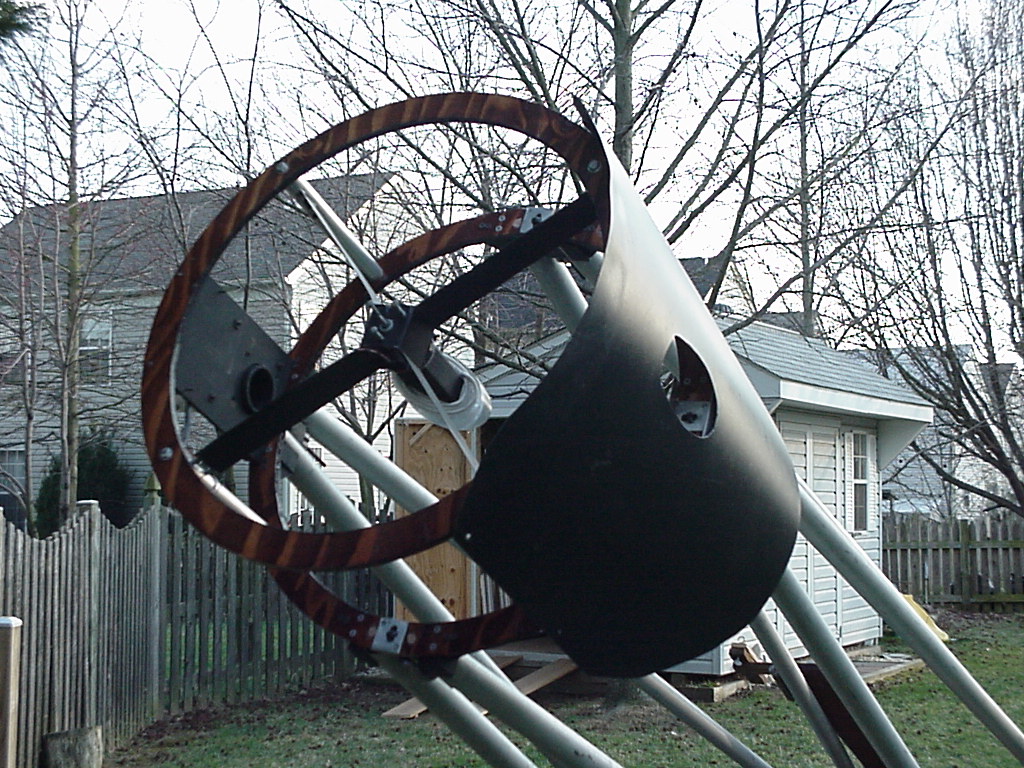
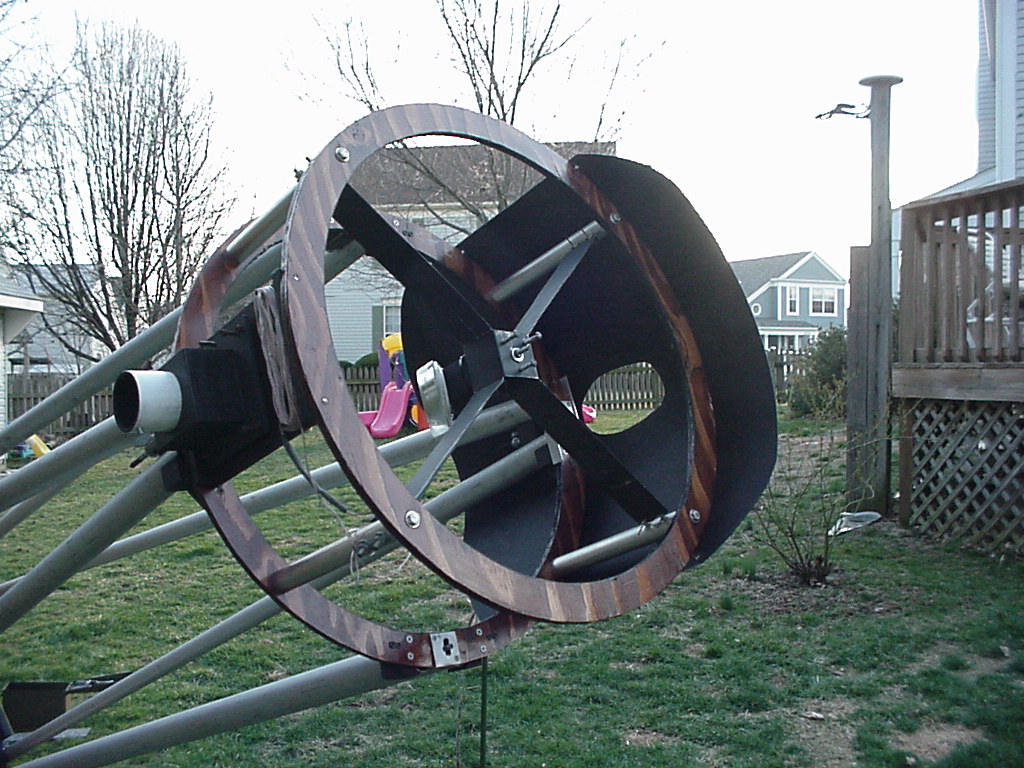
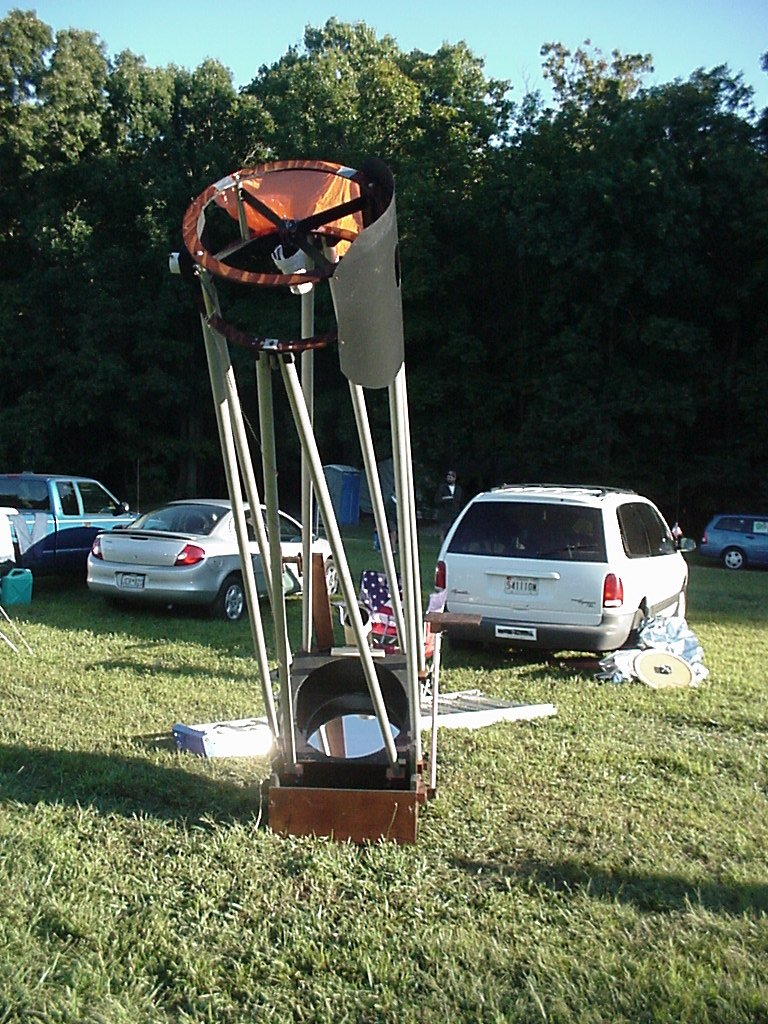
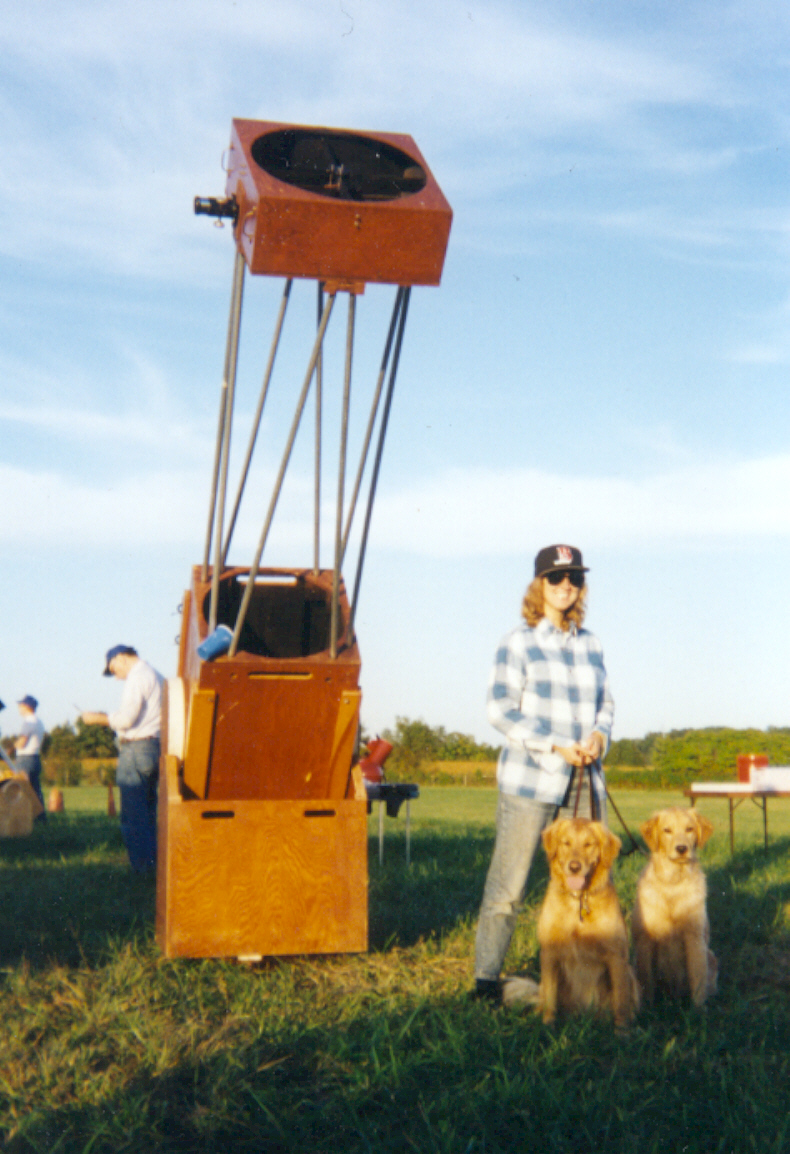
"TJ" is a 20-inch f/6.4 dobsonian telescope. The current version of TJ (version 2.1) was completed by Bob Bunge in 1999 and updated in the fall/winter of 2001. It is pretty much a Kriege/Berry clone with a few exceptions that will be touched on later.
TJ got it's entry into the world as a United Lens pyrex blank ordered by Marshal Holman of Lillian, Alabama in 1983. I helped Marshal grind the back of the blank flat while stationed in Pensacola, FL in the Navy in 1983. Marshal finished the mirror into a classic, sonotube dobsonian in 1984. I was blessed to be at Marshal's home during first light.
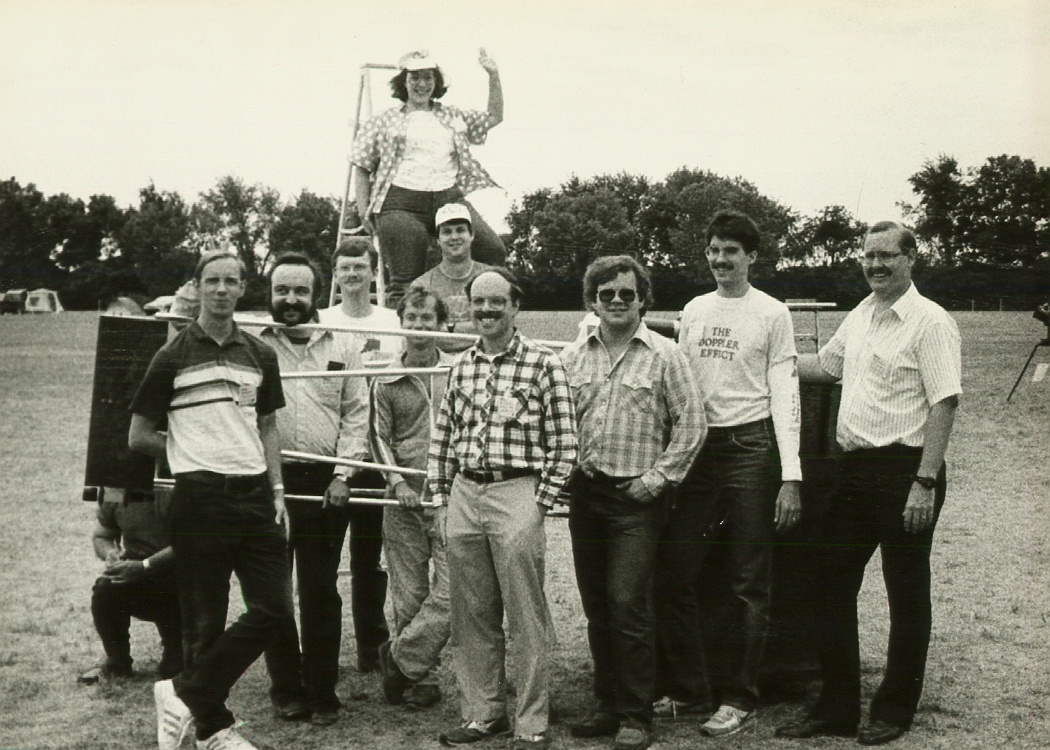
In 1986, a group of Columbus, Ohio amateurs banded together and purchased the scope from Marshal. We rebuilt the scope into a half wood/half truss tube dobsonian in 1987. This version of the scope traveled to Astrofest where it won an award for a computer pointing system installed on it by group member Bill Burton. It also traveled to Stellafane in 1987 where John Dobson himself commented on its longer-then-normal focal ratio. The scope was stored at Warren Rupp Observatory for several years and used from time to time.
In 1991, group members Tom Burns of Perkins Observatory and Jay Elkes of the Columbus Astronomical Society gifted me their shares of the telescope as a college graduation present. I call the scope "TJ" in their honor. From 1991 to 1993, the scope was in storage after moving to Maryland. In early 1993, changes were made that allowed the scope to be set up by a single person.
In 1993/94 I refigured the mirror in my basement. I used 12, 8 and 4-inch subdiameter laps to reduce rolled edge problems and worked back towards a parabola. When classic foucault testing in my basement proved difficult because of air currents, I star tested the mirror on Polaris in the scope. I did a number of figuring sessions with the mirror in the scope using an 8-inch lap and finished up in the late spring of 1994.
I received the mirror back from the coaters in July, with first light for the new TJ being the night Comet Shoemaker/Levy 9 impacted Jupiter. I was left speechless by the detail I could see in the D and G impact spots and was completely pleased by the performance of the mirror.
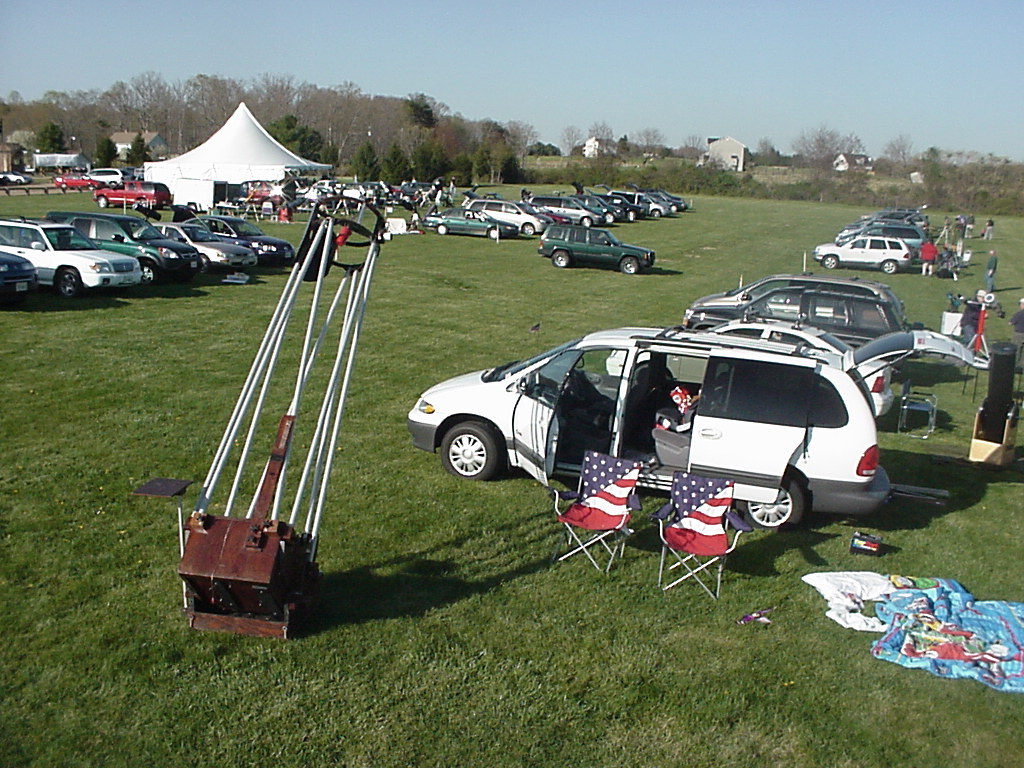
In the coming years, TJ traveled to many, many observing sessions at Crockett Park, near Catlet, VA, then a prime observing site for the Northern Virginia Astronomy Club. TJ also made trips to Starfest (1996) in Canada, Hidden Hollow, back at it's old Ohio stomping grounds, Winter Star Party (1997) and several times to the nearby Delmarva Stargaze, also a normal observing site. At Crockett Park, in 1996, I helped more than 300 people look at the core of Comet Hyakutake in the span of about four hours with TJ. Another memorable observation was of Mars at WSP in 1997. The seeing conditions were sub-arcsecond and the detail was terrific. Even nearby AP refractorheads were impressed. At third memory moment were the vivid reds and greens seen in the nucleus of comet Hale-Bopp from Skyline Drive in Shenandoah National Park.
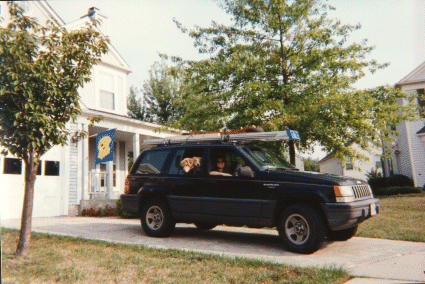
Throughout this time, longer trips with TJ in our Jeep were limited by lack of space to bring along our two Golden Retrievers, Lady and Tramp. TJ weighed in at about 350 lbs and took up most of the room in the Jeep. So in 1999, I started a long-awaited rebuilding of the scope into a modern Kriege/Obsession style telescope that would at least halve the weight and reduce the volume of space TJ took up it the Jeep.
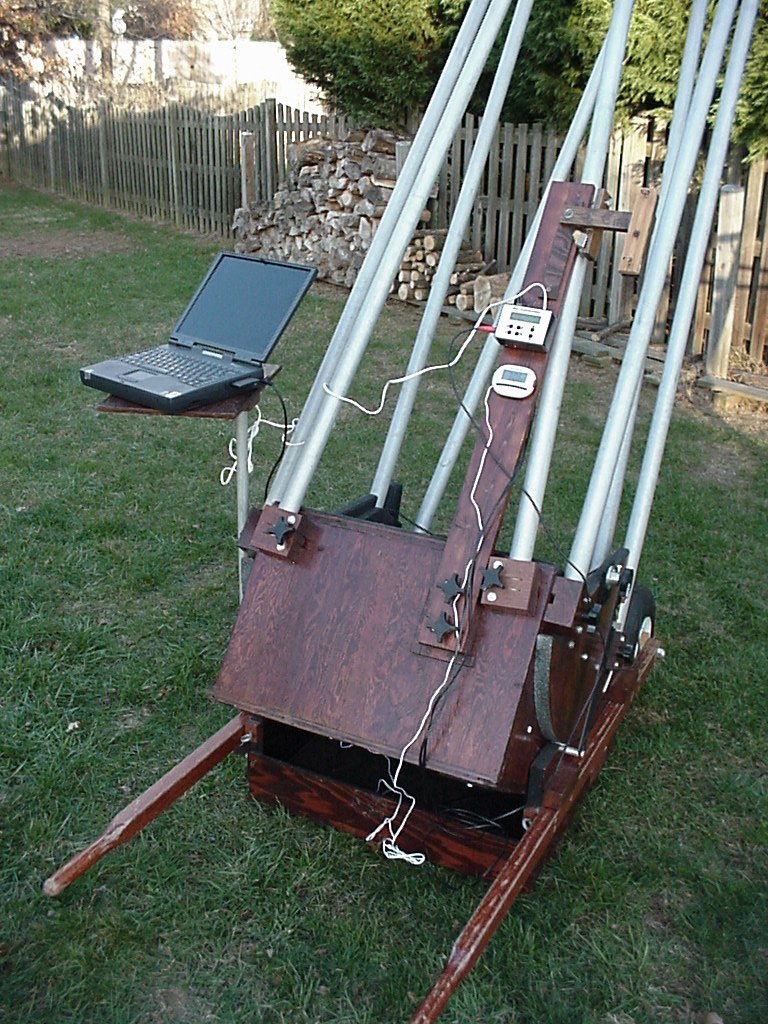
Construction of TJ2 went fast and smooth, with first light being in the fall of 1999 with first "Dark Light" being at the 1999 NOVAC Star Party at Crockett. The original 1-inch OD struts used on TJ2 proved not to be up to the task, so in 2000, I rebuilt the scope with larger, more stable strut poles (1 5/8-inch OD). TJ2 has also been to Delmarva and in 2001 traveled via Autotrain to the Winter Star Party. In the spring of 2001, TJ2 had changes made to it's focus cage and other minor improvements. New light for this configuration of TJ2 (TJ2.1 :-) was with the Greenbelt Astronomy Club's 2001 Astronomy Day show. More minor improvements have fine tuned the scope some more since then. TJ2 is equipped with a Sky Commander Digital Setting Circle system. A small table attaches to the rocker box that can hold a laptop running Megastar that is interfaced with the Sky Commander.
In November and December of 2001, I added a simple 12-volt power system to TJ2 to power the laptop computer, the secondary mirror and eyepiece dew heaters, as well as to supply power to the Sky Commander for cold weather operations. I've detailed this system on a separate web page. In June, 2002, I built a shelf to hold a 72 amp/hr Marine Deep Cycle battery. The shelf is made from 1/4-inch luan plywood and slips onto the front of the rocker box, between the wheels.
During 2003, I laid some patio stones in the backyard to support TJ for a season of Mars observing. While observing Mars one night, I got curious and made a 17-inch aperture stop. I knew that this would have the affect of removing a rolled down edge that the mirror suffers from (this is a major advantage of making your own mirror... you understand it's weaknesses). This turns TJ into a 17-inch f/7.8 newtonian! The planetary images greatly improved. From April through October, I made more than 40 drawings of Mars, most with TJ. In August, 2003, the Washington Post ran an article about amateur astronomers watching Mars that featured TJ and a drawing made through it. Similar drawings were made during the 2005 season.
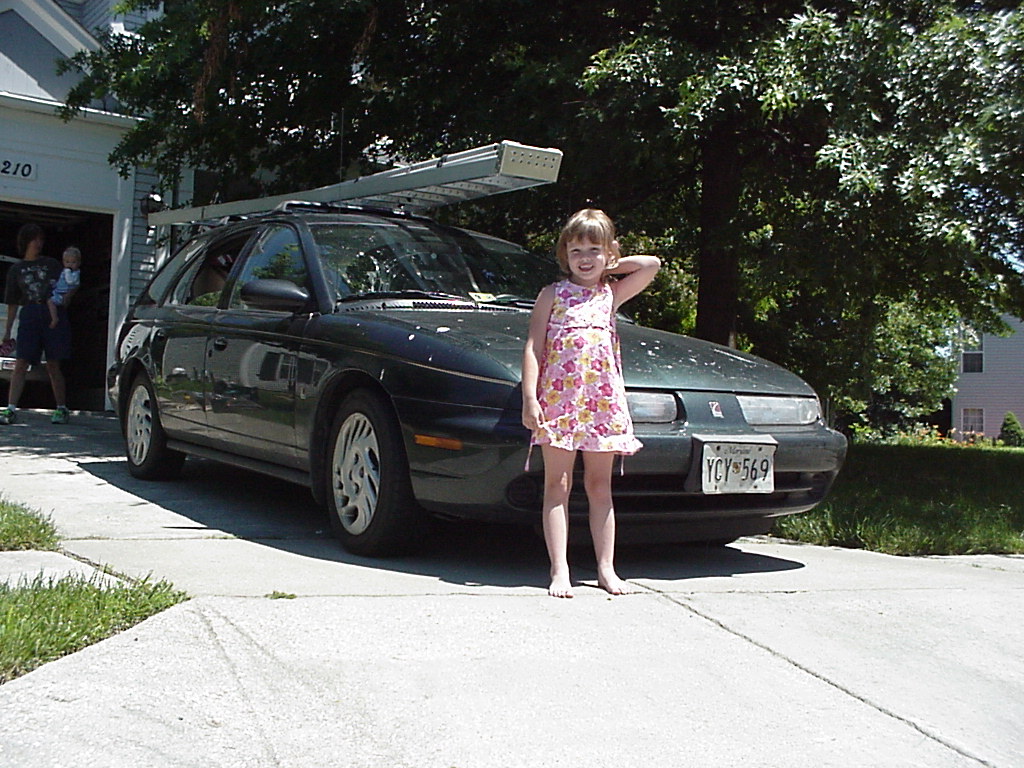
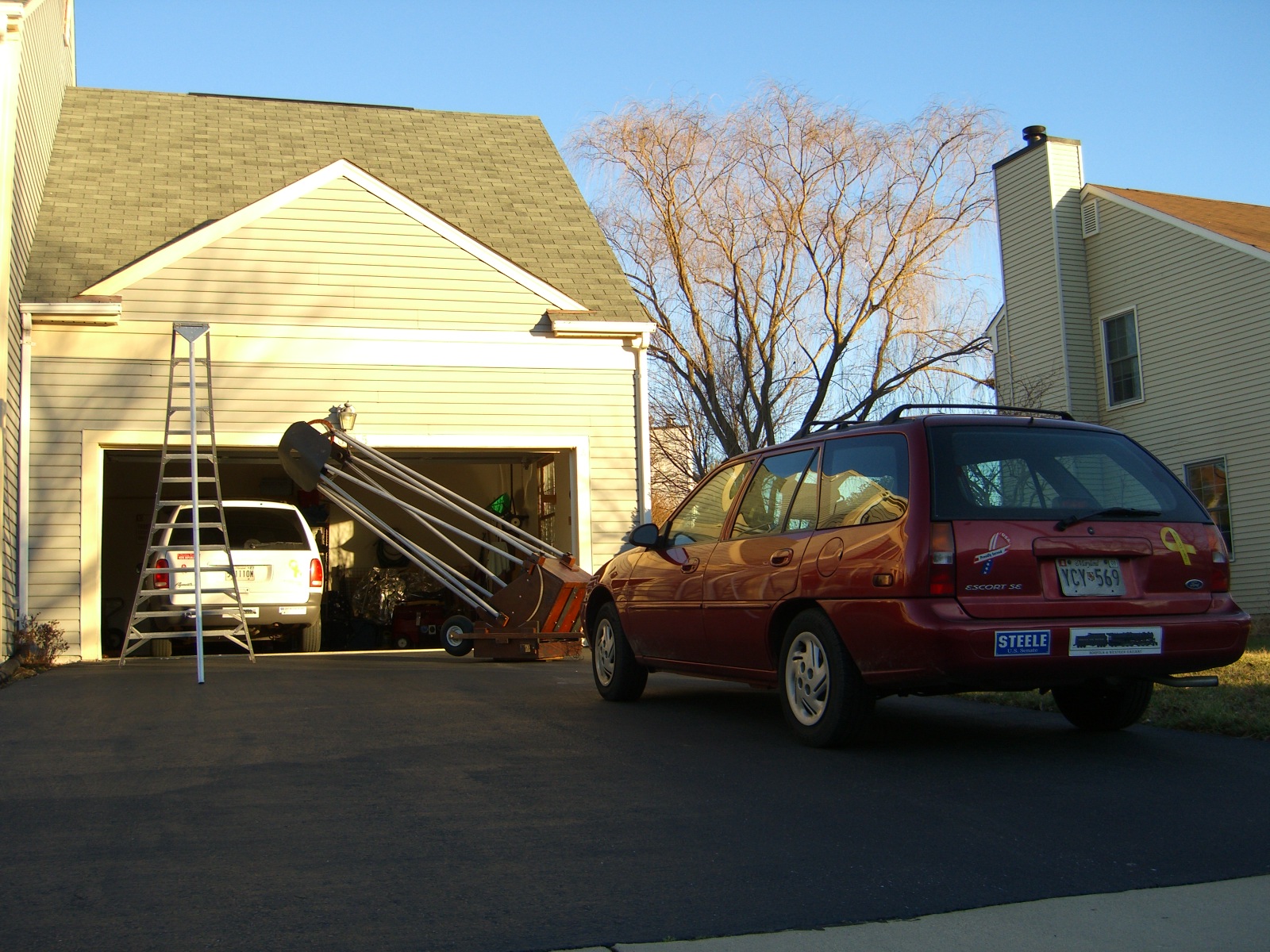
In 2004, I figured out how to stuff TJ into the back of a 1998 Saturn SW2 wagon. This saved load up time compared to the Minivan I had been using and provided more flexibility. Additional work included tweaking the design of the wheel barrow handle quick disconnect. In 2005, the Saturn was exchanged for a Ford Escort Wagon. I loaded the scope up once in this car before realizing I could shave additional load up time by trimming two inches off the end of the wheel barrow handles, allowing them to stay on during transport.
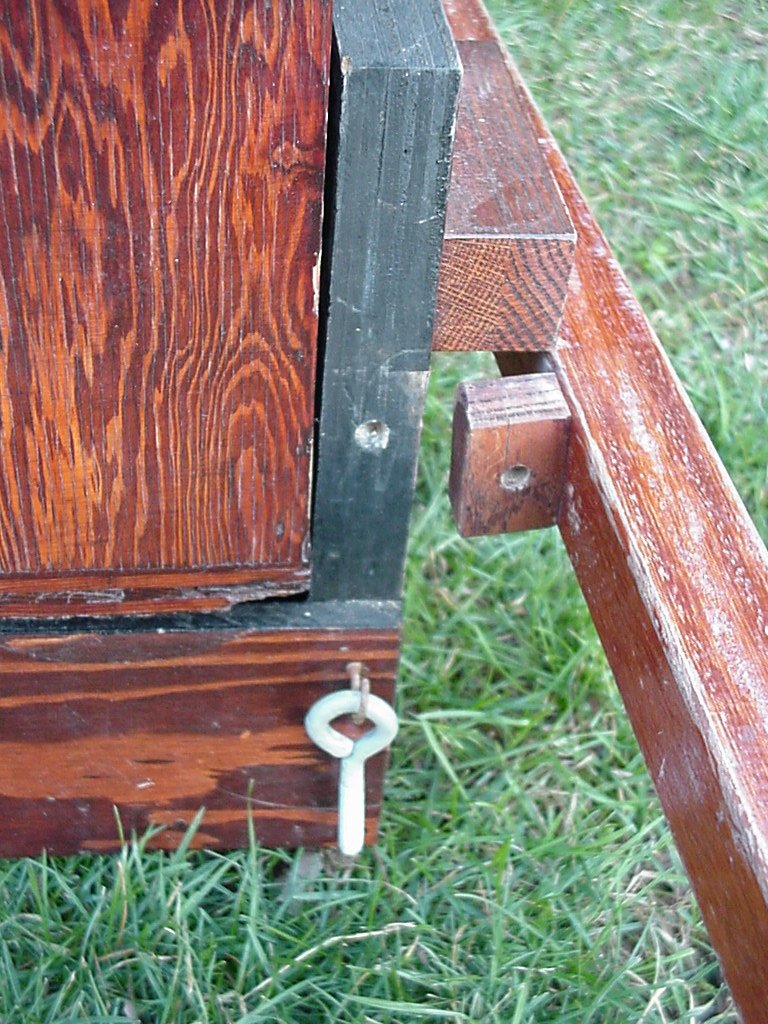
After several years of more use then anything else, in 2006, TJ finally got some TLC. This was kicked off when after record dry weather in late March, the truss blocks on the mirror box dried out so much the poles would not fit in them. After being sanded out, it was realized there wasn't a tight screw/bolt on the mirror box and for that matter most of the telescope. After that, the large parts of the scope were disassembled and cleaned with light soap and water. The mirror box and rocker were cleaned out from all the dirt and grass that had found their way in during the 2005 Mars season. The formica surfaces were also brushed with soap, water and cleaned.
The biggest part of the project was a rebuilding of the supports for the wheel barrow handles. Wood pegs were replaced with steel and aluminum since over the years, the wood pieces had broken a couple of times and were generally in bad shape even though made from oak. First light and test for this was Astronomy Day, 2006 at Goddard Space Flight Center. Prior to going to the Almost Heaven Star Party, additional tweaks were made to the secondary dew heater system. Solder joints from the spider vanes to the heater cord on the secondary had proven over the years to break or come loose under regular transport conditions. Holes were drilled and 4/40 threads to were tapped in the vanes behind the secondary mirror shallow to provide secure and tight electrical contacts.
I like to use TJ to observe Mars from my urban backyard. Under dark skies, I've been tracking down and drawing all of the Arp Peculiar Galaxy Clusters. My favorite dark sky site is Spruce Knob, a West Virginia mountaintop that is a 4 hour drive from home.
After setting up TJ at the 2009 (fall) Tuckahoe Star Party, things started to go south quickly. At certain points in altitude motion, there were "bumps" as you moved the scope. The digital setting circles didn't hold lock at all... and objects weren't were often several fields of view away from where the DSC/computer said they were.
I actually wasn't too surprised there were problems. I had been using TJ regularly for a couple of years, yet providing little or no TLC; with family and work life I was lucky just to get any observing time, let alone much time for the telescope's upkeep. Yet, there was another reason as well; I had honed TJ into a mean observing machine. There wasn't much reason to tweak anything as I finished off observing all 338 Arp objects and started in on the Herschel 400 list.
Upon arrival back home, for the first time in several years, a good inspection of the scope was had. The most impressive discovery was that after 22 years of abuse and wear and tear from gravity, the glue and nails holding the bottom board of the mirror box had started to fail and the bottom had pulled loose by about a half inch. This was large enough so the board was hitting the azimuth encoder. This neatly answered the question as to why the DSC had failed at Tuckahoe. Close inspection showed several of the nails used in 1987 were almost completely rusted through and the glue used was not to be seen. However, more alarming was that every one of the truss blocks made in the 1999 update were cracked and clearly subject to failure. These clamps, made just before the Berry/Kreige book had come out, were made from solid pieces of maple, whereas Dave and Richard recommended layers off glued board instead.
The immediate problem, the mirror box based, was solved by deploying some new glue and using wood screws to hold the board in place. Even though I knew maple to be the wood of choice for the clamp blocks, I decided to experiment with easy to get red oak boards from the local big box hardware store. They glued together well enough; the boring of the 1 5/8th hole went well enough, but almost as soon as I started to attach them to the scope problems arose. First off, when I dropped one, it broke. Another, when on the scope cracked when I purposefully stressed it by pulling on the truss. So a 2nd set of blocks were constructed from poplar wood. These blocks were also slightly thicker.
On November 21st, 2009, I set up TJ at Tuckahoe once again. The scope worked flawlessly. More important, I was able to pick off the last three Arp galaxies, completing a 10 year quest to observe and draw all 338 of these objects. TJ had been used to to see the first and last, compiling a total of 298 objects from ten different locations:
| Big Meadows, Shenandoah National Park, VA | 12 objects |
| Camp Highroad, VA | 1 object |
| CM Crockett Park - Catlet, VA | 13 objects |
| Delmarva Star Party, Tuckahoe State Park, MD | 47 objects (three events) |
| Laurel Highlands Star Cruise, Hazelton, WV | 17 objects (two nights) |
| Nanjemoy Observatory, NCEEC, Charles County, MD | 5 objects |
| Sky Line Drive, Shenandoah National Park, VA | 9 objects (night of the 2001 leonids!) |
| Southern Park, Charles County, MD | 54 objects (a favorite winter time site) |
| Tuckahoe State Park, MD | 146 objects |
| Winter Star Party, West Summerland Key, FL | 8 objects |
The last couple of years of observing this list had added the additional challenge of early morning winter observing since a lack of clear spring evenings forced a change in observing habits.
In January 2009, TJ was featured in this Washington Post article about the NOVAC star party. Photo taken with a low end Casio point and shoot camera sitting in the grass.
As Arp observing started to wind down, I started the Herschel 400 list and also built a list of planetary nebula using Megastar. As of winter, 2011, I have about 100 Herschel objects left, but they are all winter/spring objects.
During the fall of 2011, I built a Crayford focuser for TJ.
In the fall of 2011, I also purchased a 5x10 foot trailer from Colony Cargo. This trailer is light, is long enough to hold the 10 foot ladder and is only 4 feet tall so it rides really well behind a Ford Explorer SUV.
With the trailer acquired, several tweaks were made to TJ to optimize performance for the trailer, with an eye towards reducing set up and tear down time at the observing site. The original battery shelf was showing it's age and starting to fail. It was also not designed to serve as a storage shelf for the heavy battery. A new shelf made from 1/2-inch plywood was constructed and designed not only to hold the battery all the time, but also stay on the shelf when the telescope was moved.
Another tweak was the construction of a larger roster tail shelf. One large enough to hold the computer, the sky commander and a clip board with my drawing supplies. It was also designed to stay on the scope while stored in the trailer. All of this means the scope is now stored partly assembled, and all wiring is kept in place. These two tweaks... the new battery shelf and the new roster tail trims a good 10 to 15 minutes off both set up and tear down time in the field.
Additionally, with almost all observing gear stored in the trailer, I can be off and going in about 15 minutes after deciding to go. This has allowed several sessions that I would have missed in the old days... especially those where I arrive at the site midnight or later in the cold, chasing those spring time objects. I would have never had the energy to reconfigure the SUV or van and spend an hour loading up the scope at 11pm.
By 2011, the coating on TJ's mirror was showing wear. I don't clean the mirror very often. Some dust on the surface rarely impacts performance in the field and cleaning almost always wears the coating and also risks scratches and damage. I once was set up at a star party peacefully observing dim galaxies in a corner of a field, high up on the ladder when two amateurs came over. One of the rudly pointed a white flashlight onto the mirror. Upon seeing a thick coating of dust, said "My god John, come look at this mirror." They then talked briefly how impossible it would be to see anything through this scope before moving on. I don't think they noticed me at all, high above them and they certainly have never seeen the drawing of the 15th magitude galaxy I was making at the time!
So in March of 2012, I attended the 13th session of the Mid Atlantic Mirror Making Seminar held by the Delmarva Stargazers near Smyrna, Delaware. At MMM #13, under the careful eye of expert mirror maker David Groski and with much help from Dr. Bill Hanagan and master Steve Swayze, TJ's mirror was refigured once again. This time, the rolled edge was removed and most of the remaining turned edge reduced.
After the refiguring work, the mirror was chemcially coated with silver. A tight fitting lid was made to go over the mirror and 3M silver anti-tarnish strips placed inside the cover. This has worked well and the coating lasted about a year, but a year with little use.
With some use, I decided I was not happy with the figure of the mirror, so a return to the MMM mirror making seminar was scheduled for 2015. Prior to attending, I constructed a full size lap for the mirror. Plaster was poured on the mirror and backed with plywood. The concept was to use to the full size lap to hog out glass from the center so the rolled and turned edge could be further reduced. While it proved almost impossible to get good contact across all of this lap, large amounts of glass were removed prior to attending the seminar.
At the seminar, Steve Swayze coached me through additional work with the full size lap and then eight and six inch laps. The "inside" rolled edge was elminated and the outer turned edge reduced. Steve's Ross Null test showed a good over all correction, but the mirror currently has some zones and a rougher surface then I would like. Some tests in the driveway, with the uncoated mirror suggested acceptable, if not improved performance was at hand. While the Moon and Jupiter looked great, poor seeing didn't allow for a good star test to be performed.
Nonetheless, in the spring of 2015, I took the dive and drove the mirror to Majestic Coating in New Jersey, where the owner took outstanding care of the mirror. In addition to the primary mirror, the secondary mirror was removed from the OTA and recoated. The coating on this mirror was in far worse shape then I had guessed. With the secondary removed, the OTA got a complete overhaul. All screws and bolts tightened. The dew heater system was moved, as I rarely used it. Most black surfaces got repainted. Ever troublesome bolts on the spider assembly were carefully tightened and locked down with lock-tight. The focuser was better aligned and various little issues fixed.
Upon return of the mirrors, the rest of the scope inspected. An afternoon was spent working on how the base of the scope is stored and secured in the trailer. The secondary mirror sides were repainted and the mirror glued back onto the spider.
Memorial day weekend of 2015, on Saturday afternoon, the scope was set up and the secondary mirror carefully aligned, and the DSC system tested. That evening, and the next evening, we hosted friends and neighbors over for a first light star party, looking at the Moon, Venus, Jupiter, M-5, M-13, M-104 and Saturn. Seeing still did not allow a very good star test, but at 20-inch aperture, planetary performanced appeared similar to it did when I had before stopped the mirror down to 17-inches. Post parties, more tuning was done to the entire system. Electrical issues resolved, some cords repaired, mirror box blocks adjusted and tightened, for example.
In August of 2015, Freddy, our 2007 Ford Explorer, pulled "Tracker" the trailer, carrying TJ to the Almost Heaven Star Party held at The Mountain Institute on Spruce Knob, West Virigina. The location at TMI is one of the darkest locations on the East US Coast. During the first clear night, it became apparent that I was one of only a few folks still observing at 3:30am. Talking around the next day, many folks had been dewed out. I found this interesting since TJ relies on some passive design and some simple technology to remain dew free in even heavy dewing conditions.
Since we had recently acquired some pet lizards, I happened to have a low cost IR temperature sensor with me. So the next morning, I took some readings. I have since written up a piece looking at the data (PDF file) that has since been published in a couple of club newsletters.
Upon return home, it became apparent that "Tracker" the trailor needed some TLC. The OEM mis-matched tires were a mess after a few thousand miles of service. So I learned about trailer tire maintaince and trail axle alignment. When not in use, Tracker now sits on jacks with little weight on the tires.
In the spring of 2016, I made some minor tweaks to TJ's wheels. This was to allow a more easy trip around the house to the back yard, where I set up TJ for some Mars observing. I was able to make eight drawings of Mars with TJ in May and June. During this time, TJ lived outside under the cover of a Desert Storm Shield.
In July of 2016, we returned to TMI for a wonderful three day observing run. On this trip, we took advantage of NOVAC's TMI obsring program. We set up on the top of the rise with just a few folks joining us. We enjoyed cooking our own food in TMI's kitchen, with Cathy and John snoozing in a bunk house while I slept in Tracker so I didn't wake them up in the wee hours.
Over the past several years, TJ has gotten out a few times a year, although she did spend time outside during Mars oppositions.
In early 2023 cleaned the mirror and tightened/reattached a number of blocks and just general maintenance. After a great multiday observing session at Spruce Knob TMI/Learning Experience, during the winter I installed a roof vent in the trailer along with a basic 12v power system. It powers white and red lights, the roof vent fan and includes USB and 12v power outlets. Electrical components were gotten off Amazon and Ebay. Enclosures for switches, fan speed controls, etc were 3D printed after being CADed up in Tinkercad.
Click on most images for a larger/high resolution version of the image
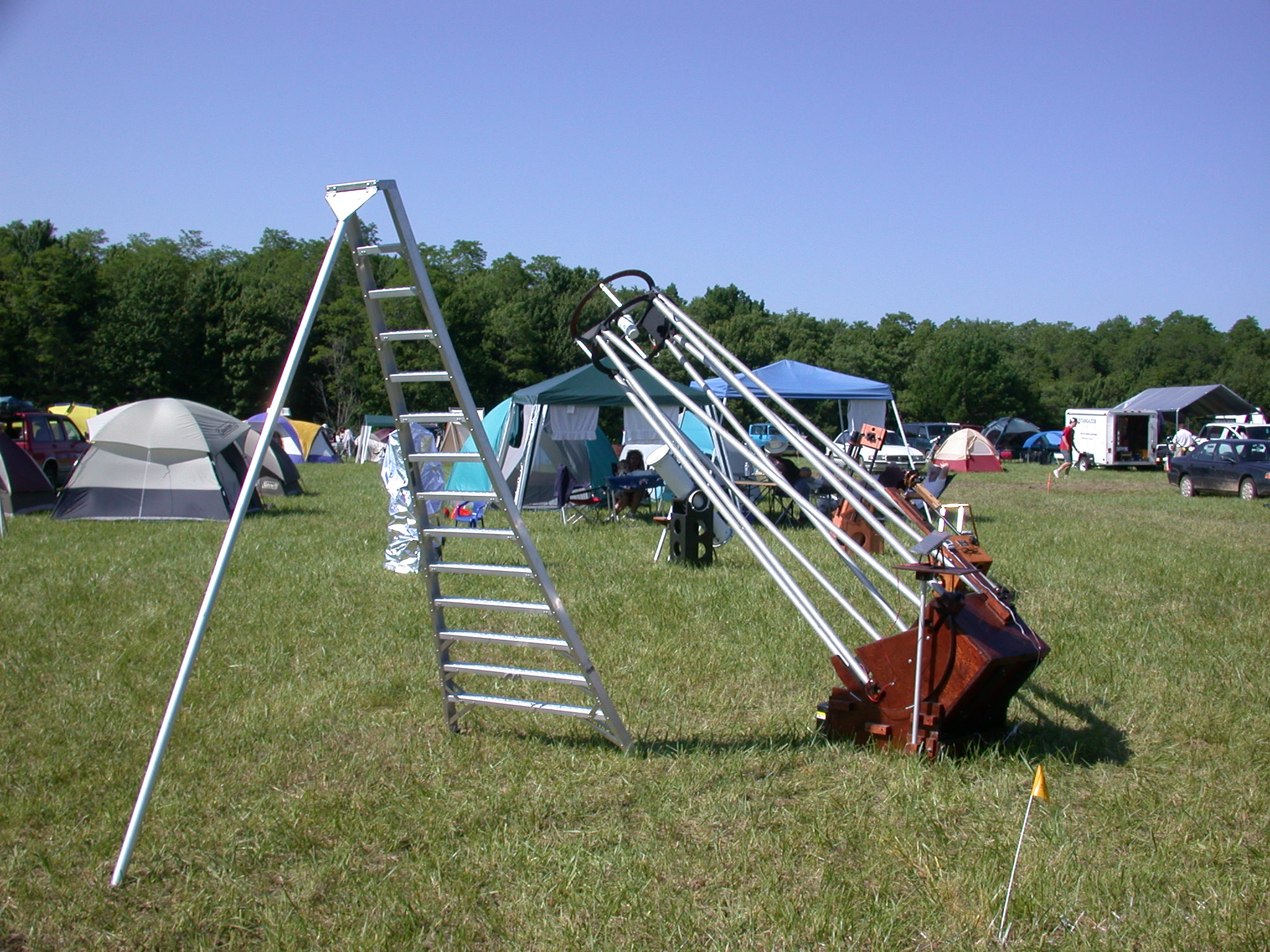
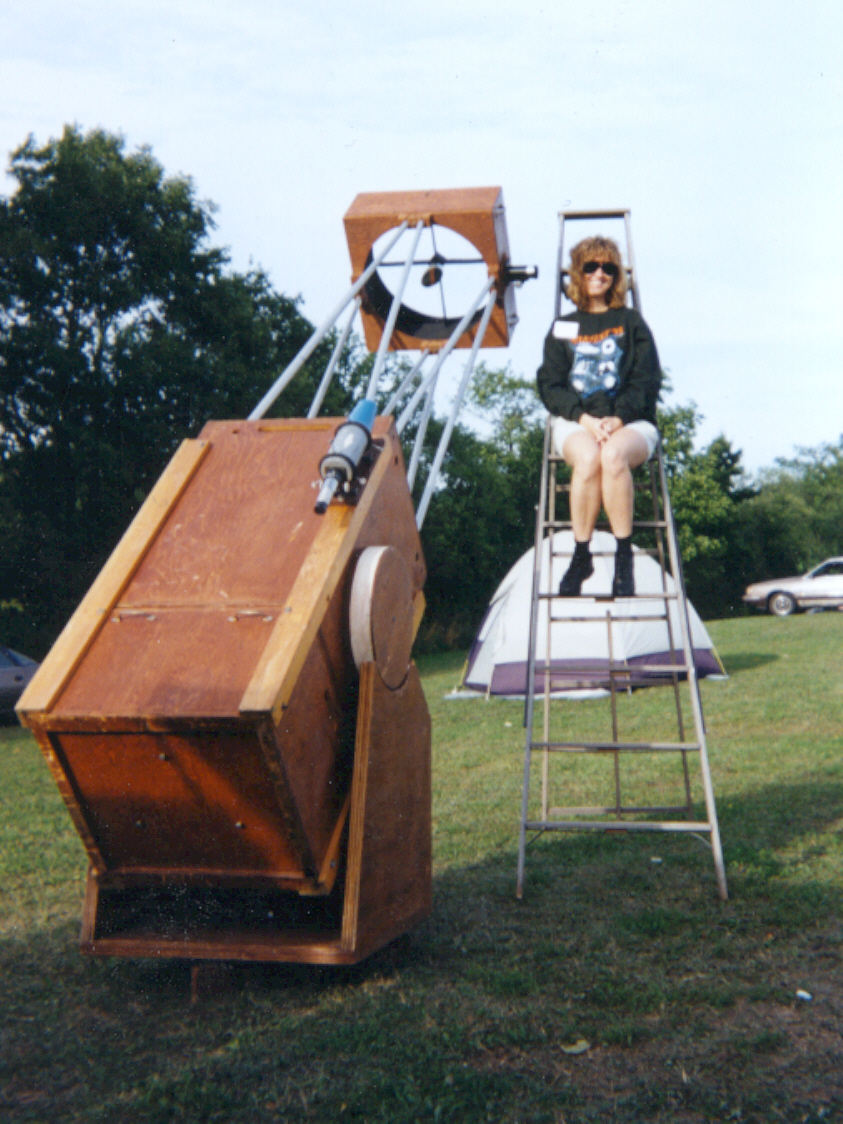
The big news in here is the ladder. This was the first serious outing for the new Tallman Astronomers Tripod Ladder. This is a wonderful ladder that beats normal ladders hands down. The tripod is very stable, the extra width greatly increases stablity and the ladder is designed to sink into the ground, improving stabilty even more. Finally the steps are only 8-inches apart, so rarely is the eyepiece "between" steps.
TJ is so tall, it is almost impossible to use a finder scope mounted to the focus cage. Besides, the weight at the top would be a pain to counterbalance. My solution can be seen here: I mount a "riser" board to the mirror box that sticks up high enough to support a finder scope at a good height. I normally only keep a simple board that has two eyelets on it. I use this to rough aim the scope at either bright planets or at two bright stars at the start of an observing session. The DSC's use these two stars to figure out where the scope is pointed and I normally just use the DSC's to navigate for the rest of the session.
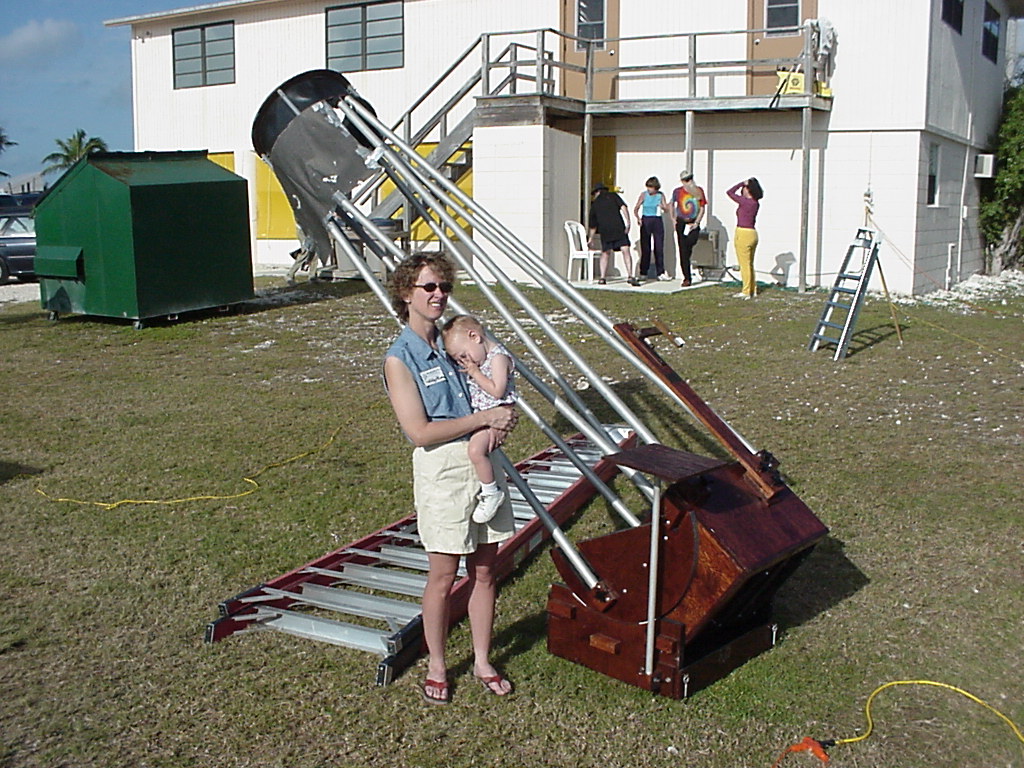
This is after about a week at the party, so we are all tired and about ready to go home after a very successful trip! We had taken the Autotrain down to FL from DC, so I wasn't able to bring a ladder on the train. We rented a 12-foot fiberglass ladder from a nearby hardware store.
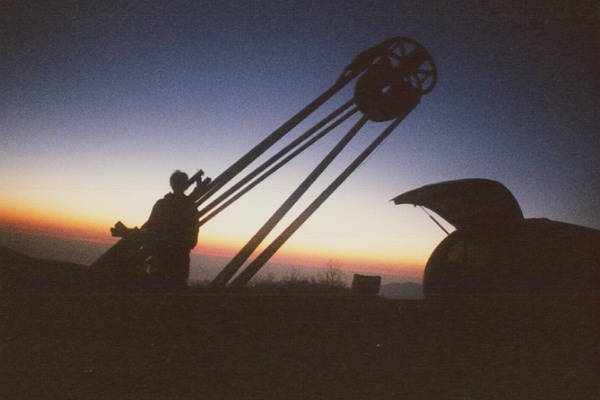




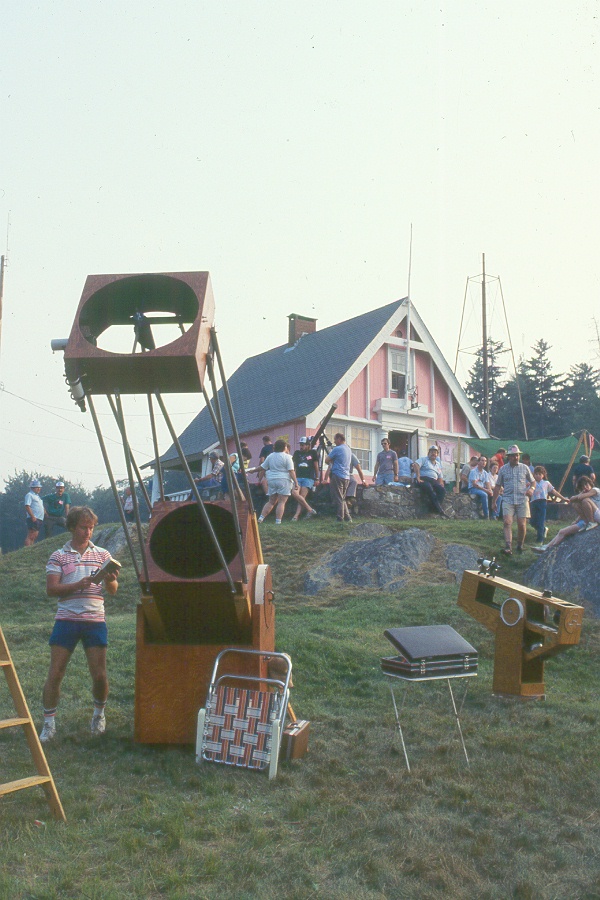
The famed pink A-frame Stellafane club house is in the background. Beside TJ is Tom Burn's wonderful 6-inch f/20 Tri-shief. with optics by Dick Wesseling.
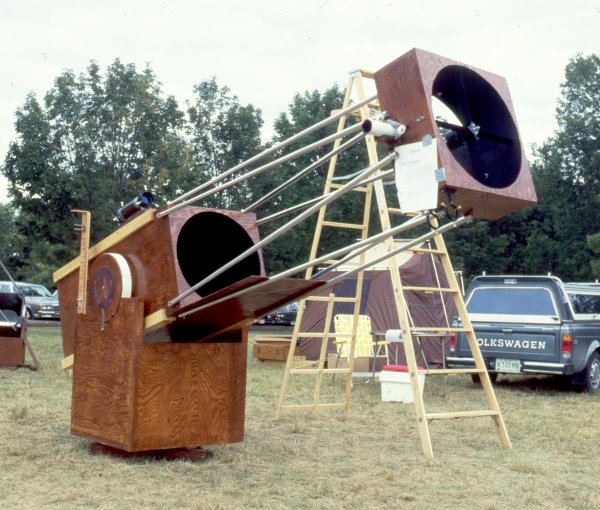
Bill Burton's surveyor's setting circles are mounted on the scope. There is a protractor on the side bearing. Just behind the bearing, attached to the rocker is a vertical board that held a surveyor's compass. Bill ran a program, written in BASIC, by John Kerns on an old Radio Shack pocket computer. The computer had something like 8k of RAM and could store all 110 Messier objects in memory! Input the RA and Dec, and it output the alt-alz. Dial them in and the telescope was pointed! It really worked. Richard Berry of ASTRONOMY magazine was impressed enough to run an article with a print out from Bill's computer with the code for program. But a single line of code was cut off during printing. Richard recieved dozens of letters and swore off printing computer code! Bill won an award at this party for the pointing system.
Behind TJ, is Brent Archinal's old Volkswagen pickin-up truck. I can't count the number of hours I spent following this truck around from star party to star party. For this party, Brent's truck had carried large parts of the TJ from Ohio.
Other interesting tidbits include that we had a small 50mm finder mounted on the focus box and the struts were attached with straight through bolts and wing nuts, not clamped with Ron Ravneburg's system. This version of the scope was pretty shaky. But shoot, it was big and collected lots of photons! Also shown is the original 10-foot wooden ladder. This version had an early attempt at a homemade crayford PVC pipe focuser. This didn't last long.
This also a good shot showing the original configuration of rocker box sides: squared off all the way up the top. This made putting the OTA in the rocker very difficult. It took at least three people to lift the OTA on the rocker.
It should be noted that the very next year, Dave Kriege brought his first Obsession design scope to Astrofest, making this design old, anicent and out-of-date!
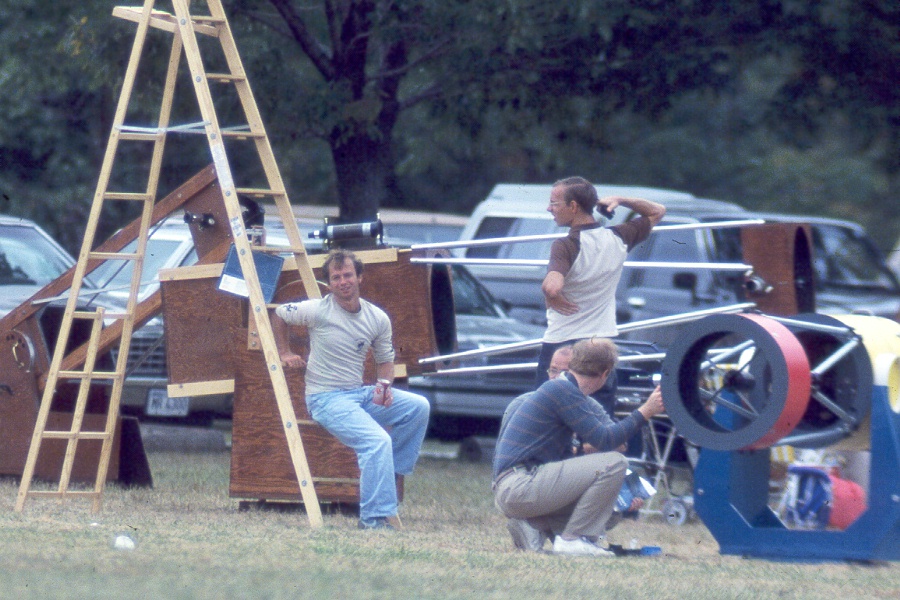
Behind TJ, you can see the second version of the Columbus Astronomical Society's 16-inch f/5.6 Stewart Telescope.
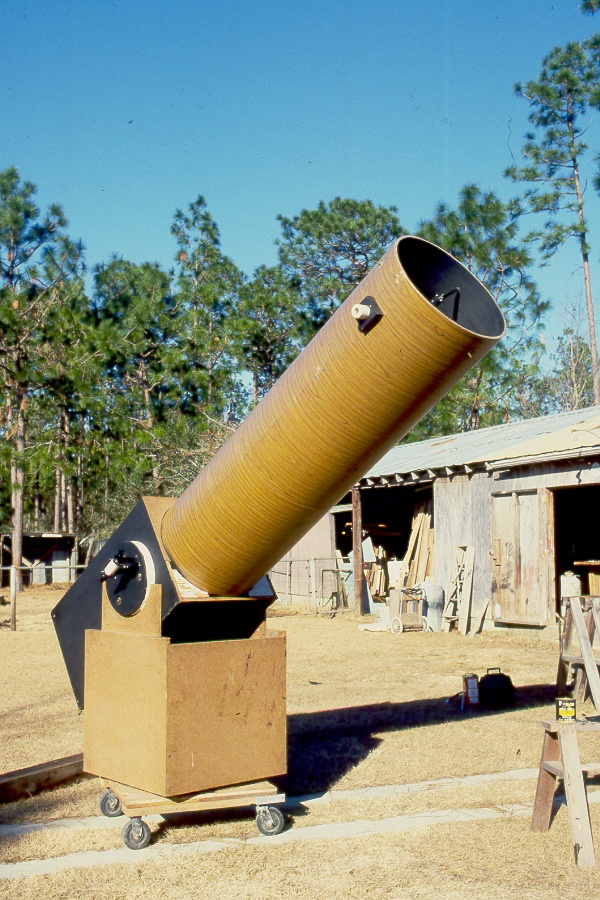
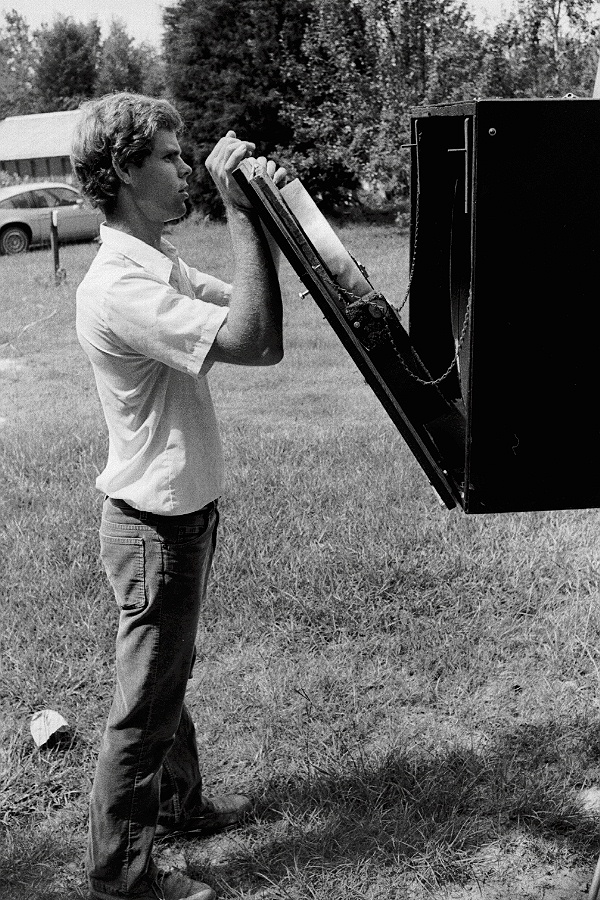
Notice we reused the huge 3-inch thick altitude bearings that Marshal had turned on a wood lathe when we made TJ1. Also the very cool PVC push-pull focuser. This version of the scope also had a classic Dobsonian tailgate for removing the mirror. This scope was originally built in 1983. I believe I took this photograph in 1986 or 1984.
Back to Bob's Homepage.
